Spaces Evolve + AI for Airplanes
Such characteristics change over time as well.
Aerospace encompasses two related categories, that of aviation (airspace) and outer space. The former is the world of pilots, airplanes, and flight paths; and the latter is the realm of astronauts, rockets, and orbital trajectories. Both contend with resisting gravity, but the fluid-like dynamics of airplane flight differs – often counterintuitively – from the weightless, momentum-governed motion of outer space. They require different skills to traverse, different equipment, different engineering, different governance. In orbital space, sometimes reversing thrust will speed you up, as you drop in altitude and take advantage of gravity. [^1]
When the Wright Brothers took their first flights, there were no regulations or established approach vectors for takeoff, flight, and landing; there were only air currents, the weather, and their wits. And they flew freely in the air… well, as far as their rudimentary airplane would carry them.
Over time, commercial and military flight became more established; airports (i.e., immovable destinations) were built; routes between airports were codified. Approach lanes were established around airports; altitudes were then striated into layers to help planes avoid each other; flight plans needed to be logged to support the efforts to manage them.
So, what was once an open and free space eventually evolved into a charted, regulated, and structured space, directing aircraft according to cooperative conventions.
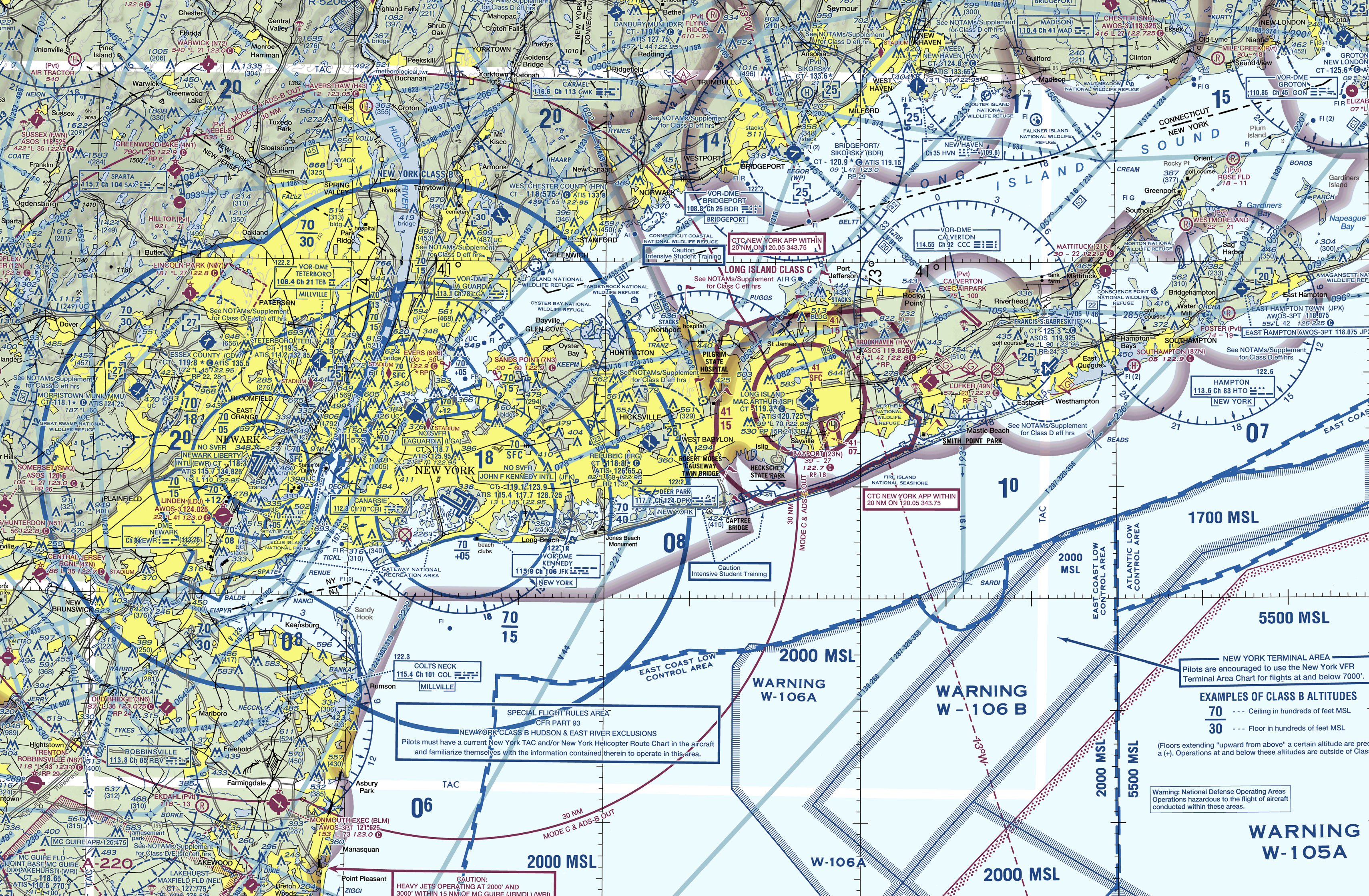 New York VFR Sectional Chart from the US FAA
The day-to-day dynamism of a busy airport is just a part of the longer evolution of air travel. An airport may serve thousands of travelers in a day, but longer term, the same airport adapts to growth, airline needs, and new aircraft technologies. Adding a runway drastically changes the surrounding airspace.
The same goes today for outer space, as more countries and companies vie for their place among the stars.
Perhaps the first commercial aircraft-related AI familiar to the public was “autopilot.” Now, many aircraft are completely fly-by-wire, that is, an aircraft’s control planes are controlled entirely electronically, originally to reflect the pilot’s input, but now (especially in military aircraft) to interpret the pilot’s intent and then execute its own commands that constantly balance safety, control, stability, efficiency, and performance far beyond what humans can achieve.