Character and Characteristics of Urban Space
The so-called “urban fabric” of a city can exhibit distinct spatial characteristics from other cities.
It’s not just about their aesthetics or cartography, although looking at maps of cities may give us clues as to their spatial similarities and differences, both formal and behavioral.
The mobility and availability of goods, people, and vehicles vary depending on many factors, such as available infrastructure, city services, street types and layout, population density, and modes of transportation (cars, bicycles, busses, trains, etc.), and how they all connect and relate to each other.
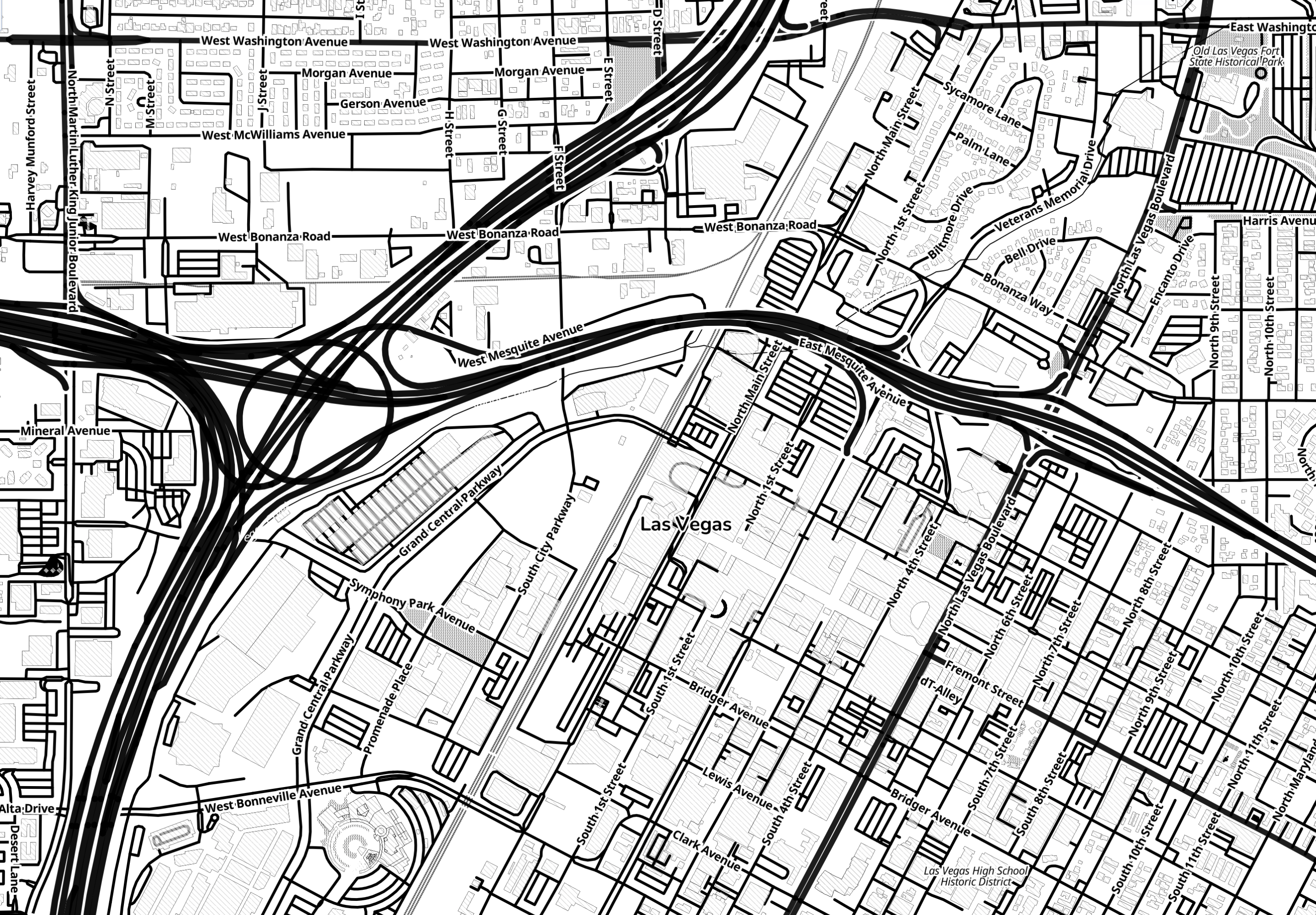
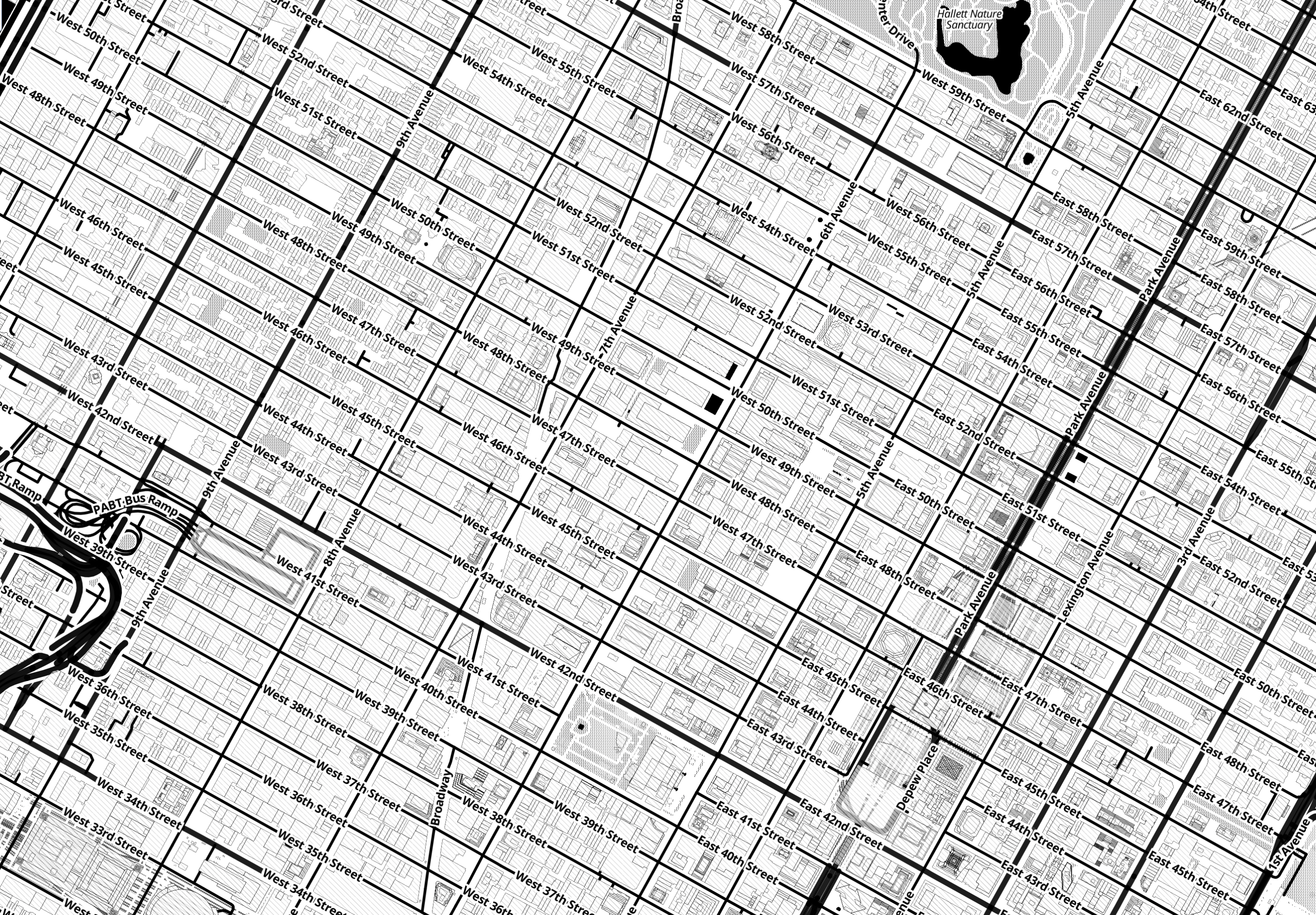 Midtown Manhattan from MapTiler.com
Manhattan’s rectilinear grid, ultimately a means of control, contrasts to the more organic yet automobile-oriented fabric of Las Vegas.
New York City can move millions of people each day with MTA’s subway system[^2], but transporting goods faces the frictions and hindrances of the crowded street grids and bottlenecked bridges. In the neighboring New Jersey, goods can flow through the port to adjacent distribution centers to highways much more fluidly. The latter space is more enabling for goods, but less so for people, and Manhattan is the opposite. There is something about the nature of these places that present a different kind of space, depending on what is moving through them.
Urban space is inherently composed of overlapping and often conflicting qualities.
The growth and development of a city over time depends on the market, policies, availability, features, and pricing of land, funding, and the political environment.
When we visit and walk, ride, or drive around a new city, we form mental maps of nearly everywhere we go. These are comprised of our spatial memories – what we saw on the last street we walked through, where we had lunch relative to our office, etc. These mental maps are naturally quite different from city to city, but individuals make their own distinct maps from their own experiences of the same city as well.
What is shared among these mental maps becomes a kind of fingerprint of a city’s spatial character. Was it easy to get around on foot? Was it easier in a car? Was it difficult to know how to get to your destination? Did you need to reference a map or to ask someone? Did you enjoy yourself or was it stressful?
The experience of walking Manhattan’s Financial District, with its concrete canyons, narrow streets, and ubiquitous crowded sidewalks, supplies a cacophony of activity. As pedestrians hurriedly scurry around each other, they nevertheless pause to wait for the signals that it’s safe to cross the street. At the same time, vehicles make their way, stop-and-go, through gated intersections and around pesky cyclists who seem to emerge from nowhere. Foot and vehicle traffic interweave everywhere, both aided by a common coordinate system of streets and avenues (e.g. “34th and 8th”).
The old Las Vegas strip, however, is characterized by its deference to automobiles, obligatory parking lots, cloverleaf exchanges, wide boulevards, and precarious medians. This part of Las Vegas space operates at the speed of the highway, scaling everything else to the perceptions of fast-moving drivers guided by bombastic signage. Once cars are parked, drivers become pedestrians, and the air-conditioned threshold is crossed, this space yields to vast indoor environments of flashy casinos and themed hotels.


(Downtown Manhattan Photo by Nikoloz Gachechiladze on Unsplash | Las Vegas Strip Photo by André Corboz on Wikimedia Commons)
.jpg)
Even these photographs need different orientations to reflect the experience of these urban spaces. The vertical monumentality of Lower Manhattan space conjures a deep crevice carved from solid stone, but the horizontal fast-flowing Las Vegas space is an open field populated with a different kind of monument, the sporadic and attention-seeking commercial signage that stand on their own.